

White Flag Meaning in a Relationship: The Real Definition
 By admin
Renata remembers a couple who came into her office after a fight about, of all things, a dishwasher. Not really about the dishwasher. About who always gives in first. One partner said, half-joking, “I guess I’ll wave the white flag again,” and the other one’s face changed instantly — like the phrase itself had done more damage than the argument.
That’s the strange thing about “white flag” in relationships. It sounds simple. It isn’t. Depending on who’s saying it, when, and how, it can mean anything from a healthy act of letting go to a quiet signal that someone is exhausted and one step from checking out entirely.
The term has exploded across TikTok and Instagram over the past couple of years, usually grouped alongside red flags, green flags, yellow flags, and beige flags — a whole color-coded vocabulary for describing relationship dynamics in a single word. But white flags get less attention than the others, and that’s partly because their meaning shifts more than any flag in the set.
This article breaks down what white flag actually means in a relationship, where the phrase comes from, the difference between a healthy white flag and a warning sign disguised as one, and what to do if you or your partner keeps raising them. We’ll also look at how AI search tools are now answering this exact question for a growing number of people who type it into ChatGPT instead of Google.
What Does “White Flag” Actually Mean in a Relationship?
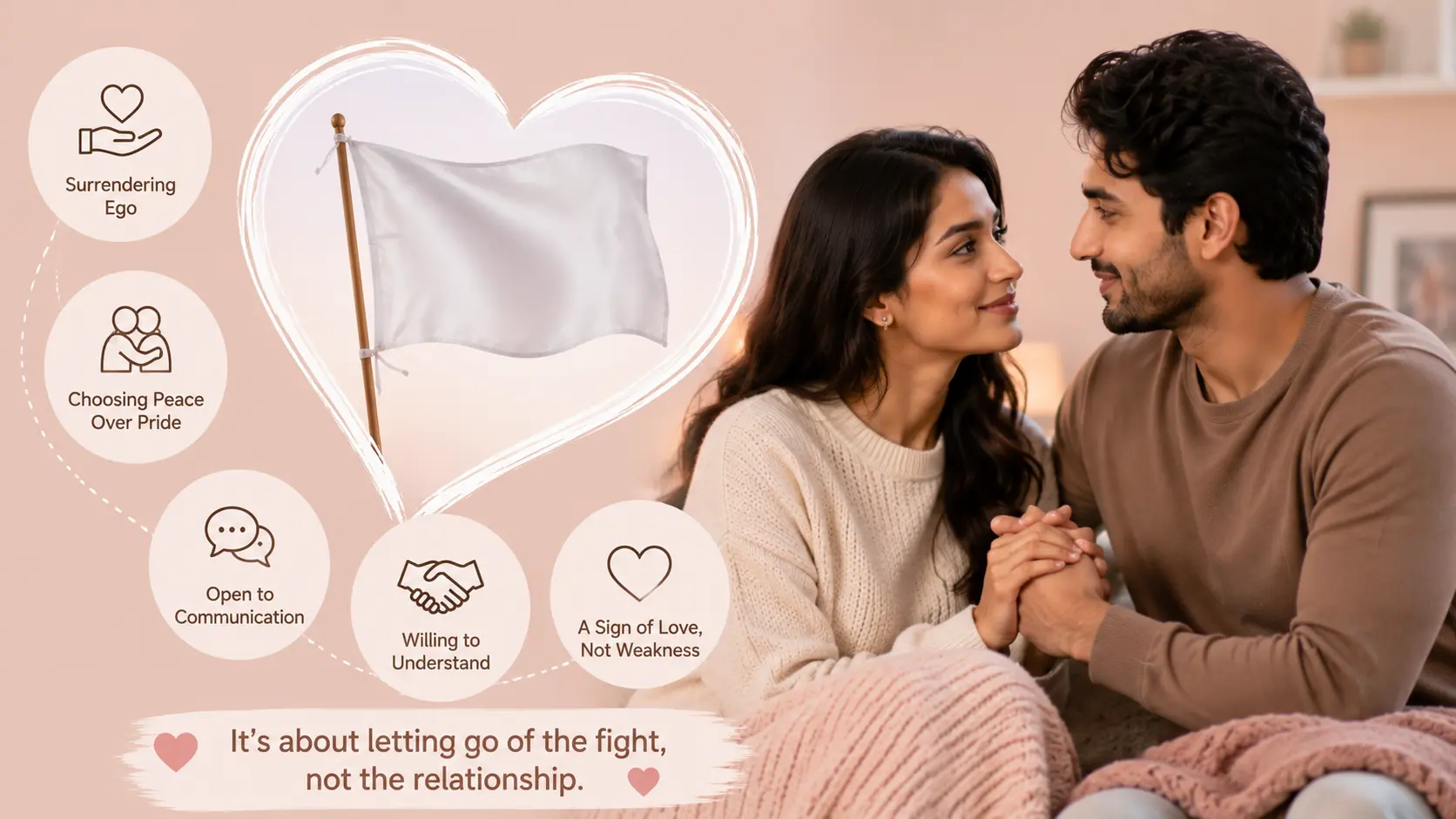
The white flag has meant surrender since long before it had anything to do with dating. Armies used a plain white cloth to signal a ceasefire — a request to stop fighting and talk instead. That military origin is still doing most of the work in the relationship version of the phrase.
In a relationship, waving the white flag usually means choosing peace over winning. It’s the decision to stop pushing a point, let go of being right, and prioritize the relationship over the argument. Malik, who tracks relationship terminology trends across social platforms for a living, sees this as one of the more misunderstood terms in the current flag vocabulary.
“People assume white flag automatically means giving up on the relationship,” Malik says. “Most of the time it means the opposite. It’s someone choosing the relationship over their own ego in that specific moment.”
That said, the phrase genuinely does carry more than one meaning, and context changes everything. A white flag raised mid-argument, meaning “I don’t want to fight anymore, let’s talk,” is different from a white flag raised after months of repeated conflict, which can signal something closer to emotional exhaustion or resignation. Both usages are common. Neither is wrong. The skill is learning to tell them apart.
White Flag vs. Red Flag vs. Green Flag: How the Colors Compare
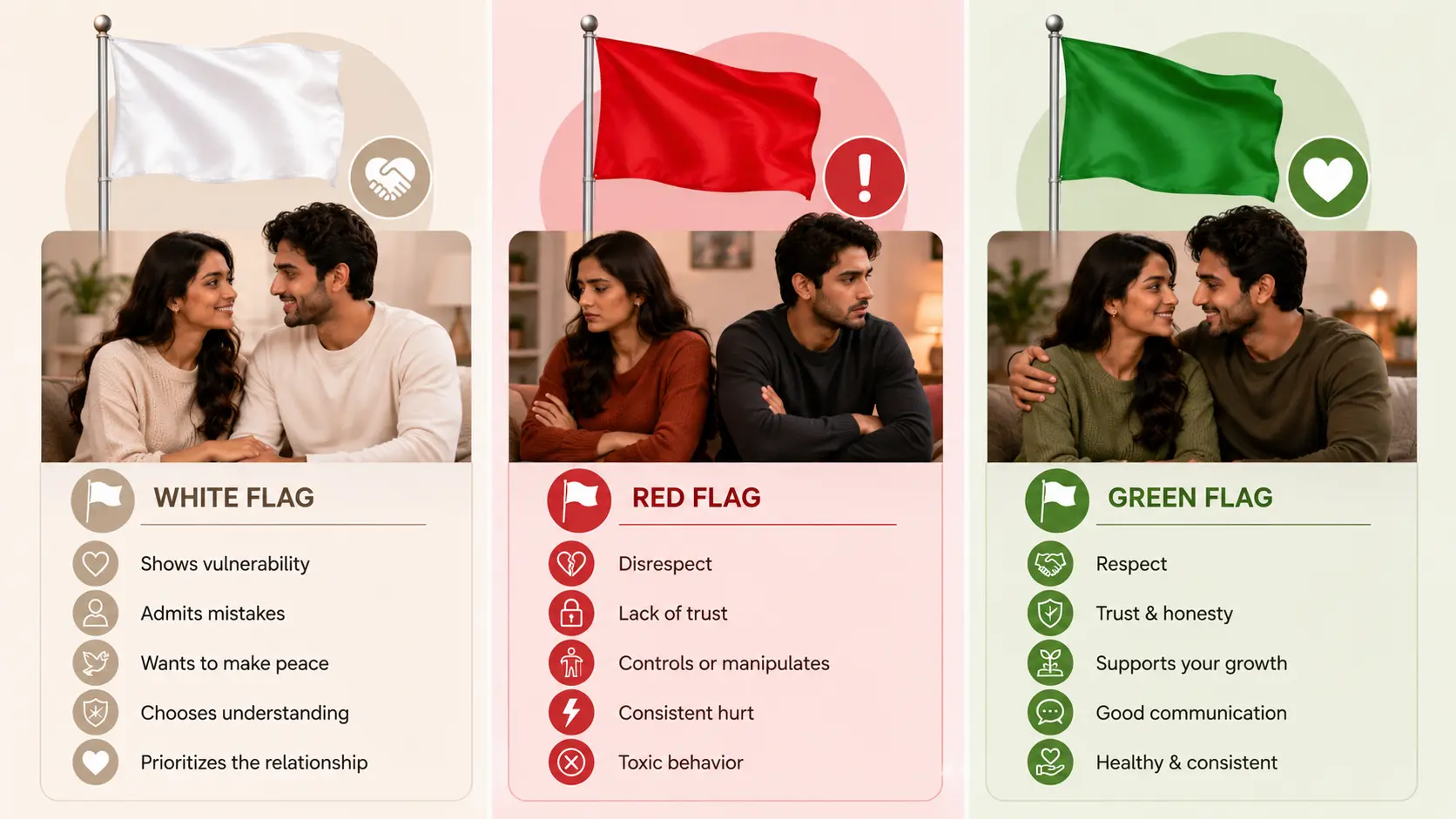
The relationship flag vocabulary has grown fast, and it helps to see white flags next to their more familiar counterparts.
A red flag signals a warning — a pattern of behavior that suggests something is unhealthy or even harmful, like controlling behavior, dishonesty, or disrespect. Red flags are about protecting yourself from a partner’s behavior.
A green flag signals the opposite: consistency, respect, honesty, emotional availability. Green flags describe traits worth valuing and building on.
A yellow flag sits in between — not necessarily dangerous, but worth watching. Something that needs a conversation before it becomes a bigger issue.
A white flag is different from all three because it’s not primarily about identifying a partner’s traits. It’s about an action, usually your own: the decision to stop fighting, compromise, or let something go for the sake of the relationship. Where red, yellow, and green flags describe what someone is, a white flag describes something someone does in a specific moment.
This distinction matters because white flags, unlike red flags, aren’t inherently good or bad. A red flag is almost always worth taking seriously. A white flag’s value depends entirely on whether it’s coming from a place of genuine choice or from quiet burnout.
Healthy White Flags: What Compromise Actually Looks Like
Renata sees healthy white flags in her practice constantly, and they tend to share a few features: they’re small, they’re mutual over time, and they don’t cost either partner their sense of self.
Some everyday examples of healthy compromise in relationships: letting your partner pick the restaurant even though you had somewhere else in mind. Not pushing to finish an argument the moment you both go to bed angry, because you both know a clearer conversation is possible in the morning. Accepting your partner’s comfort clothes and bad Tuesday-night hair without commentary, because being fully relaxed together matters more than looking put-together for each other.
“The mistake I watch couples make,” Renata says, “is thinking every disagreement needs a winner. A healthy white flag moment is when both people can say ‘this isn’t worth the damage it would cause to keep fighting about it’ — and actually mean it, not just say it to end the conversation.”
Healthy white flags tend to go both directions. If one partner is always the one raising it — always the one who apologizes first, backs down first, or gives in first — that’s usually a sign the pattern has tipped from compromise into something else.
Unhealthy White Flags: When Surrender Signals Burnout
This is where the term gets more serious, and where Malik’s trend research and Renata’s clinical experience overlap most clearly.
A white flag raised out of genuine exhaustion — after the same fight has happened for the fifth or sixth time, after repeated attempts to be heard haven’t changed anything — is a different signal entirely. It’s less “I’m choosing peace” and more “I don’t think this is going to change, so I’m stopping.”
Some signs a white flag has crossed from healthy compromise into something more concerning: it’s happening in only one direction, with the same partner always the one giving in. It’s accompanied by withdrawal rather than warmth — going quiet instead of staying engaged. It follows a pattern of the same unresolved issue resurfacing without ever actually getting addressed. Or it’s said with resignation rather than resolution — “fine, whatever” instead of “okay, I hear you.”
This kind of white flag often overlaps with what’s sometimes called relationship burnout: a state where one or both partners have stopped believing that effort will change anything, so they stop putting in effort at all. It can look like peace from the outside. Underneath, it’s often closer to giving up quietly rather than resolving anything.
The difference matters because the response is completely different. A healthy white flag deserves acknowledgment and gratitude. A burnout white flag deserves a real conversation about what’s actually going on underneath it — not just relief that the fighting has stopped.
How AI Search Is Changing the Way People Learn Relationship Terms

A growing number of people now ask ChatGPT, Perplexity, or Google’s AI Overview to explain “white flag meaning in relationship” instead of scrolling through search results. This shift changes what kind of content actually gets surfaced and trusted by these tools.
Generic definitions that just restate the dictionary meaning of surrender get flattened into a single forgettable AI sentence. Content that distinguishes between the different real-world uses of a term — healthy compromise versus burnout, mutual versus one-sided, mid-argument versus long-term pattern — gives AI systems something specific and citable to draw from. That’s the foundation of generative engine optimization, or GEO: writing content that AI tools can accurately extract and attribute, rather than content built purely to rank on a traditional results page.
Answer engine optimization (AEO) works alongside this by structuring content around the actual questions people type into AI tools, in a format that’s easy to pull cleanly — which is why the FAQ section below mirrors the real, specific queries people search rather than generic prompts.
For relationship content specifically, this rewards nuance over simplicity. A page that explains when a white flag is healthy and when it isn’t has a real advantage over a page that just says “it means surrender,” because that’s the kind of depth AI tools are increasingly built to prioritize and cite.
Bringing It Together: Reading Your Own White Flags Clearly
The phrase “white flag” survives in relationship language because it captures something real: love does require letting go of the need to win, sometimes constantly. But the same phrase can describe two very different experiences — one that strengthens a relationship and one that quietly erodes it — and the only way to tell them apart is to pay attention to the pattern, not just the moment.
If you keep noticing that you’re the one raising the white flag more often than your partner, working with a relationship coach can help you figure out whether that’s healthy flexibility or a pattern worth addressing before it turns into resentment. If you’re newly dating and trying to figure out where healthy compromise ends and settling begins, a dating expert can help you build that discernment early.
Couples heading toward marriage often benefit from working through this exact dynamic ahead of time — pre-marital guidance can help you establish what fair compromise actually looks like before old patterns get baked in. For couples already navigating a long-term relationship where white flags have started to feel one-sided, marriage guidance can help rebalance things before burnout sets in.
If a relationship has already ended and you’re trying to understand whether the white flags along the way were healthy compromise or quiet warning signs, breakup recovery support can help you make sense of the pattern in hindsight. For those rebuilding after a divorce, divorce healing support addresses the deeper work of learning to compromise without losing yourself in the next relationship. And if the constant giving-in has left you feeling anxious or depleted, anxiety support can help address what’s happening underneath the pattern itself.
Frequently Asked Questions
It usually means they’ve decided to stop arguing and prioritize the relationship over being right in that moment. Depending on context, it can also signal deeper exhaustion if it’s said after repeated, unresolved conflict rather than a single disagreement.
Not inherently. A healthy white flag reflects genuine compromise and mutual give-and-take. It becomes concerning only when it’s one-sided, accompanied by withdrawal, or used as a way to avoid addressing a recurring issue rather than actually resolving it.
A white flag is usually specific to a moment or issue — letting go of one argument, one preference, one point of contention. Giving up on the relationship is broader and more permanent, reflecting a decision that the relationship itself isn’t working, not just that a particular disagreement isn’t worth having.
Healthy white flags tend to be mutual over time, said with genuine acceptance rather than resignation, and followed by continued engagement rather than emotional withdrawal. Burnout-driven white flags tend to be one-sided, repeated around the same unresolved issue, and followed by distance rather than closeness.
The term originates from its military use, where a plain white cloth signaled a request for a ceasefire or truce. It carried into relationship language as a metaphor for choosing peace over continued conflict, and gained renewed popularity through social media alongside terms like red flag and green flag.
Letting a partner choose where to eat without pushing your own preference, not finishing an argument the moment you’re both too tired to communicate well, or accepting a partner’s off-days without commentary are all common, low-stakes examples of healthy compromise.
No. Avoiding necessary conflict entirely isn’t the same as healthy compromise — it can actually prevent real issues from being addressed. A healthy relationship needs both the willingness to raise a white flag on small things and the willingness to have direct conversations about bigger ones.
It’s worth having an honest conversation with your partner about the pattern, ideally outside the heat of an argument. If the imbalance continues despite that conversation, it may be a sign worth exploring with a relationship coach or therapist, since one-sided compromise tends to build resentment over time even when both people mean well.
A white flag in a relationship was never really about losing. It’s about deciding, in a specific moment, that the connection matters more than the point you were trying to make. That’s worth protecting. What’s worth watching for is whether that decision stays mutual — whether both people are occasionally the one who lets go — or whether it’s quietly become something only one of you keeps doing. Pay attention to that pattern, and the flag tells you almost everything you need to know.