

Why Emotional Intelligence is the secret to finding the right partner in 2026
 By admin
What if the reason you haven’t found the right partner has nothing to do with luck, timing, or the kind of person you attract — and everything to do with a skill you were never taught?
Emotional intelligence — the ability to understand, manage, and communicate your emotions in relationships — is the most underrated and underdeveloped skill in modern dating. Research now confirms what relationship psychologists have known for years: emotional intelligence in relationships is a stronger predictor of long-term love, compatibility, and emotional safety than personality, physical attraction, or shared interests combined. People with high EQ don’t just date better — they love better. They choose better. They build something that actually lasts.
And here’s what makes this genuinely exciting: emotional intelligence skills are not something you’re born with or without. They are learnable. Trainable. Developable — at any age, in any stage of life. Whether you’re trying to break a pattern of choosing the wrong people, heal from dating burnout, or finally build the kind of relationship that feels safe and real, emotional intelligence is the foundation for everything else that is built.
In 2026, the most attractive thing about you isn’t your appearance or your achievements. It’s your EQ. This is what relationship experts wish everyone understood before they started searching for “the one.”
What is Emotional Intelligence — And Why Does It Define Your Dating Life?
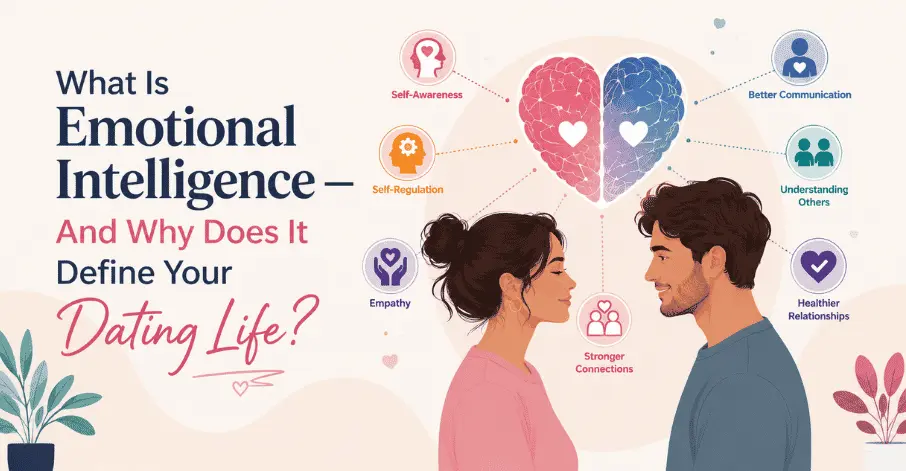
Emotional intelligence is defined as the ability to identify, understand, and manage your own emotions while also recognising and influencing the emotions of others. Often referred to as EQ (emotional quotient), it shapes how you form relationships, manage conflict, communicate under pressure, and show up for the people you love.
A 2025 systematic review of research found that people with high EQ benefit from more satisfying relationships. That’s not a soft, feel-good claim. That is rigorous, peer-reviewed data telling you something most dating coaches still haven’t figured out: the quality of your relationships is directly proportional to the quality of your emotional intelligence.
Psychologist Daniel Goleman identified four key EQ skills: self-management, social awareness, relationship management, and self-awareness — each one quietly determining how your relationships begin, deepen, and either sustain or collapse. Think of it this way. Two people with similar backgrounds, similar values, and real chemistry can still build a deeply dysfunctional relationship if neither of them has the emotional skills to navigate it. And two people who are wildly different can build something extraordinary if they’ve both done the inner work.
In 2026, emotional intelligence has officially become a deal-maker in dating. Traits like empathy, self-awareness, and effective communication are now more attractive to the current generation than traditional markers of desirability. Your emotional availability is your most attractive quality. And the good news is — unlike your height or your bank balance — it’s entirely developable.
The 5 Core Emotional Intelligence Skills That Change Relationships
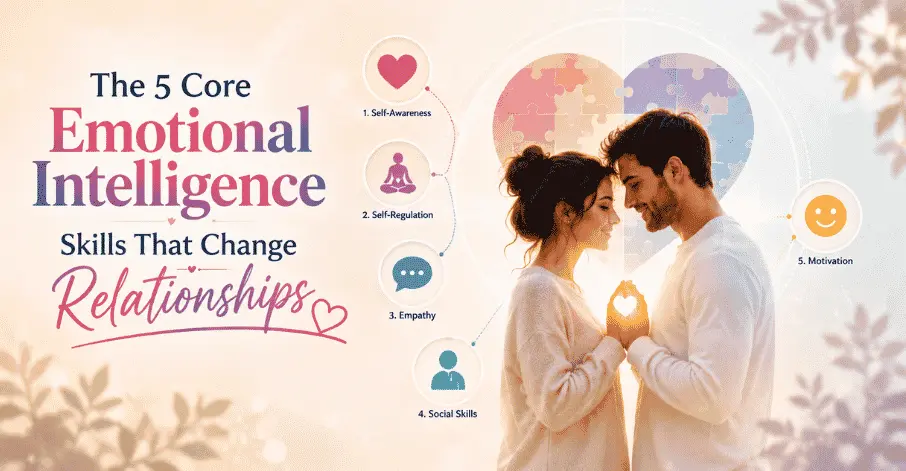
Understanding emotional intelligence in the abstract is one thing. Knowing how each skill shows up — or fails to show up — in your actual dating life is something else entirely.
1. Self-Awareness: The Foundation of Everything
Self-awareness — recognising your own emotions and how they affect your thoughts and behaviour — is the first and most foundational emotional intelligence skill. It allows you to catch negative thought patterns before they spiral, recognise your stress triggers, and understand how your behaviour impacts others.
In dating, low self-awareness looks like this: you end every relationship convinced the other person was “the problem,” without ever examining what you brought to the dynamic. You react to a partner’s silence with immediate panic, but you don’t know why. You tell yourself you want vulnerability, but you shut down the moment anyone actually gets close.
Self-awareness is asking the uncomfortable question: “What role am I playing in this pattern?” It is the difference between repeating cycles and breaking them.
2. Self-Regulation: Responding Instead of Reacting
You know that moment when a partner says something that lands wrong, and you fire back before you’ve even processed what you’re feeling? Or when you go completely silent in conflict because the emotion is too big to manage? That is low self-regulation — and it silently destroys more relationships than any compatibility issue ever could.
Self-regulation means healthy coping skills for stress management. It includes the ability to rebound from life stressors and learn from mistakes, and it directly strengthens decision-making and self-control in relationships.
In dating and relationships, self-regulation is what allows you to pause before you send that text you’ll regret. It’s what lets you have a hard conversation without it escalating into a fight. It’s what keeps you from abandoning a relationship the moment things get uncomfortable — because your nervous system has learned that discomfort is not necessarily danger.
This is where attachment theory becomes essential. Your attachment style — whether secure, anxious, avoidant, or disorganised — is essentially a reflection of how your nervous system learned to self-regulate (or not) in early relationships. If you grew up with caregivers who were inconsistent or emotionally unavailable, your nervous system may have developed a hair-trigger stress response to anything that feels like abandonment or rejection. That’s not a character flaw. That is an adaptive pattern that can be rewired, and self-regulation is the skill that rewires it.
3. Emotional Intelligence and Empathy: The Quality That Separates Good Partners from Great Ones
Empathy and social awareness allow us to relate to others. By developing empathy, you gain insight into other people’s emotions, motivations, and experiences — and that ultimately helps you build and maintain good relationships.
Empathy in dating doesn’t mean absorbing everyone’s emotions like a sponge or losing yourself in a partner’s experience. Real empathy — the kind that creates lasting intimacy — means being able to hold your own experience and genuinely understand your partner’s, even when both are in conflict.
Here’s what low empathy actually looks like in dating: it’s dismissing a partner’s feelings as “overreacting.” It’s making every argument about winning rather than understanding. It’s the person who checks their phone while you’re trying to share something important and doesn’t notice that you’ve gone quiet. These aren’t always malicious behaviours. They’re often just the result of an underdeveloped empathy muscle.
In 2026, many people — especially young adults — are afraid of vulnerability and rejection. They don’t want fewer connections; they’ve simply learned that opening up often gets them hurt. High-empathy partners create the safety that makes vulnerability possible. And that is the most powerful thing you can offer someone.
4. Emotional Intelligence and Communication: The Skill Nobody Teaches You
Most relationship problems are communication problems. But communication is not just about the words you choose — it’s about the emotional awareness behind them.
Emotional intelligence is a cornerstone of effective interpersonal communication, encompassing the ability to perceive, understand, regulate, and manage both your own emotions and those of others, enabling you to navigate conversations with empathy, clarity, and purpose.
In conversations, self-aware individuals are more likely to control their tone, words, and non-verbal cues — which means they can have difficult conversations without triggering unnecessary defensiveness, and they can receive feedback without collapsing or attacking.
Recent research on Gen Z dating patterns found that a significant portion of young women feel the men they date don’t want deep conversations, while the majority of those same men say they actually do want meaningful connections early on. The gap is not desire — it’s skill. Most people want depth. They just haven’t been taught how to create it safely. Emotional intelligence and communication are the bridge between wanting connection and actually building it.
In the Indian context, this matters enormously. Many of us grew up in homes where emotional directness was rare — where love was expressed through actions, not words, and where conflict was either avoided or explosive. Learning to communicate with emotional intelligence, in many ways, means learning a language you were never taught. That’s not failure. That’s growth.
5. Relationship Management: Turning Individual EQ Into Partnership
All four previous skills culminate here. Relationship management means knowing how to develop and maintain good relationships, communicate clearly, inspire and influence others, and manage conflict effectively.
In dating, relationship management is what allows you to navigate the slow, imperfect, deeply human process of building something real with another person. It’s knowing when to push for honesty and when to give space. It’s being able to repair after conflict without nursing resentment. It’s understanding that love is not a feeling you fall into — it’s a skill you build, every single day.
“Why Do I Keep Choosing the Same Toxic Partner?” — The EQ Explanation
This is one of the most common questions people bring to therapy. And the answer, almost universally, involves emotional intelligence — specifically, the intersection of low self-awareness and unresolved attachment patterns.
When you haven’t done the inner work to understand what you’re actually looking for in a partner — versus what your nervous system recognises as familiar — you will keep choosing familiarity over compatibility. If chaos or emotional unavailability is what love felt like in your earliest relationships, your system will seek that out, not because you want to suffer, but because it feels like home.
In 2026, many young adults are actively talking about red flags, emotional manipulation, gaslighting, and unhealthy patterns. This self-protection mindset is helping them make better emotional decisions — even if it sometimes means walking away from someone they care about. That growing awareness is emotional intelligence developing in real time. It’s a generation learning, loudly and collectively, what previous generations processed only in private or not at all.
How to Know If You’re Emotionally Ready to Date
This question matters more than most people realise. Emotional readiness is not about having zero baggage — everyone has a story. It is about having enough self-awareness to take responsibility for your patterns rather than unconsciously inflicting them on someone else.
You are likely emotionally ready to date if you can answer yes — honestly — to the following:
- You can identify your emotional triggers without blaming others for activating them
- You know your attachment style and recognise when it’s driving your behaviour
- You can sit with discomfort or uncertainty without immediately seeking external reassurance
- You have life interests, friendships, and goals that exist independently of any relationship
- You can end something that isn’t working without catastrophising or prolonged self-destruction
You may not yet be emotionally ready to date if you are using a new relationship primarily to escape loneliness, unresolved grief, or a previous heartbreak. That’s not a moral judgement. It’s simply an honest recognition that you deserve to enter relationships from a place of wholeness — not from a place of urgency or emotional hunger.
Dating Burnout Solutions: When EQ is Depleted
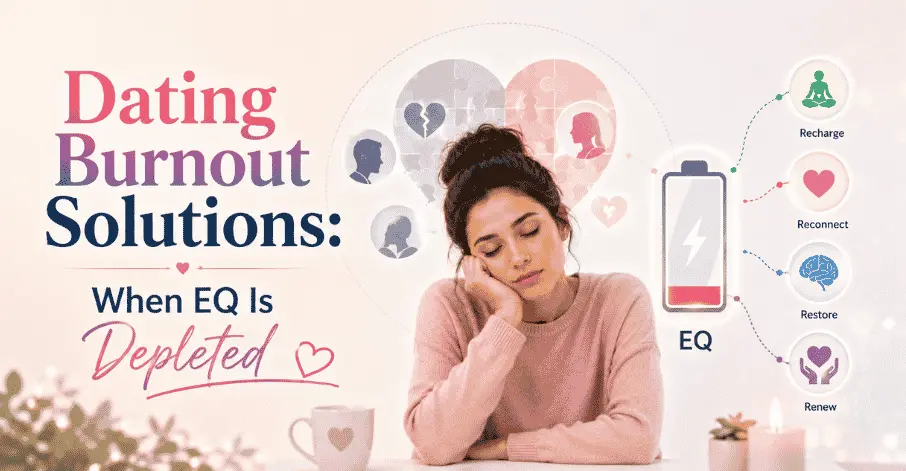
The daters who thrive in 2026 are not the ones chasing volume — they’re the ones who bring self-awareness, presence, and emotional steadiness into the room. It’s less about getting noticed and more about being someone worth choosing.
Dating burnout is real, and it is a direct consequence of low-EQ dating environments. Going on dates that feel hollow, investing emotionally in people who aren’t available, staying in situationships out of fear of loneliness — all of it depletes your emotional reserves. The solution is not to date more. It is to date with more emotional intelligence.
Practically, this means setting clear emotional boundaries before you begin — knowing what you’re looking for, deciding how much emotional energy you’re willing to invest each week, and being honest enough with yourself to walk away from dynamics that cost more than they give. ROEmancing — evaluating relationships like emotional investments, where the return is consistency, clear communication, and practical support — reflects a cultural shift where chemistry alone no longer drives dating decisions. That shift is EQ in action.
How to Improve Emotional Intelligence: Practical Starting Points
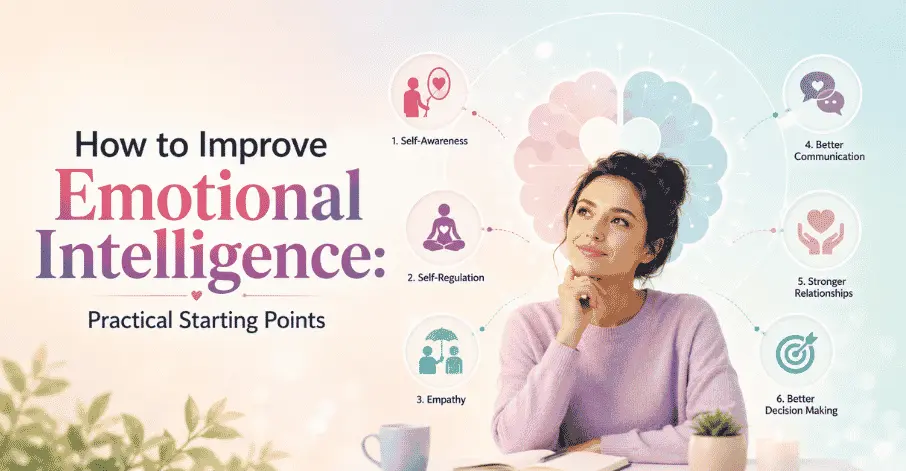
Emotional intelligence is not a fixed trait. It is a set of skills, and like every skill, it can be developed with practice, guidance, and honest reflection. Here is where to begin:
Build self-awareness by journaling after emotionally charged interactions. Not to vent — but to examine. What did I feel? What triggered it? What did I do with it? What would I do differently?
Develop self-regulation by practising the pause. Before you respond to a charged message or statement, take 90 seconds. The emotional wave peaks and begins to fade at that time. You don’t have to react to the peak.
Strengthen empathy by asking genuine questions and listening — not to prepare your response, but to actually understand. Make curiosity your default mode in early dating.
Improve communication by replacing “you always” and “you never” with “I feel” and “I noticed.” The shift from accusation to expression changes the entire temperature of a conversation.
Seek emotional intelligence training or coaching — in the form of therapy, attachment-focused coaching, or even the right books. Daniel Goleman’s foundational work, Emotional Intelligence, remains a landmark read. Brené Brown’s research on vulnerability and connection is equally powerful and widely accessible.
Conclusion
Here is the truth that 2026’s relationship landscape keeps trying to teach us: you can improve your appearance, refine how you present yourself, read every book on attraction — and still feel completely lost in relationships. Because the gap most of us are dealing with is not a strategy gap. It is an emotional intelligence gap.
Emotional intelligence is the skill that determines whether you attract partners who match your values or just your wounds. It’s the thing that helps you communicate what you need without shutting down or exploding. It’s what allows you to be genuinely present with another person — not managing them, not performing for them, but actually with them.
Your attachment style, your communication patterns, your capacity for empathy, your ability to self-regulate under pressure — all of it is emotional intelligence, expressed in real time, in your real relationships. None of it is fixed. All of it is learnable.
So the question isn’t whether you’re “good at” relationships. The question is whether you’re willing to grow. And if you’ve read this far, you already are.
Read More: Wildflowering Dating: The Softest Dating Trend GenZ Is Quietly Embracing
Frequently Asked Questions
Emotional intelligence in relationships is your ability to understand and manage your own emotions while also recognising and responding to your partner’s. It includes skills like self-awareness, empathy, emotional communication, and conflict regulation — all of which determine how deeply and sustainably you can connect with another person.
The five core EQ skills, based on Daniel Goleman’s framework, are: self-awareness (knowing your emotions), self-regulation (managing your reactions), motivation (directing emotional energy purposefully), empathy (understanding others’ emotions), and social skills/relationship management (building and maintaining healthy relationships).
Common signs of low EQ in dating and relationships include: frequently blaming partners without examining your own patterns, struggling to identify or name your emotions, reacting impulsively during conflict, difficulty empathising with a partner’s experience, and a pattern of relationships ending for similar reasons.
Absolutely. EQ is not fixed. Research consistently shows it can be developed through self-reflection, therapy, coaching, intentional practice, and emotionally safe relationships. Unlike IQ, emotional intelligence responds directly to effort and lived experience.
Your attachment style — secure, anxious, avoidant, or disorganised — is essentially the blueprint your nervous system developed for emotional regulation and closeness in relationships. Attachment theory and emotional intelligence are deeply connected: insecure attachment often results in underdeveloped self-regulation and empathy, while healing your attachment patterns is one of the most direct routes to higher EQ.
Start by getting clear on your non-negotiables before you begin meeting new people. Decide in advance how much emotional energy you can genuinely invest each week — emotional bandwidth is finite. Be honest early about what you’re looking for, and treat misaligned values or intentions as useful information, not personal rejection. Boundaries in dating are not walls — they’re filters that protect your emotional investment and keep you from giving everything to someone who was never right for you.
This is almost always rooted in attachment patterns formed in childhood. If emotional unavailability or inconsistency was what love felt like early in life, your nervous system learned to associate that pattern with “home.” You’re not choosing dysfunction consciously — you’re choosing familiarity. Therapy, especially attachment-based approaches, helps you understand this pattern and gradually shift toward choosing partners based on genuine compatibility rather than unconscious recognition.
Emotional maturity in dating means showing up with enough self-awareness and self-regulation to take responsibility for your feelings and actions, communicate honestly without manipulation, handle uncertainty without panicking, and respect a partner’s emotional reality even when it differs from yours. It’s the difference between reacting to relationships and consciously participating in them.
Real-world EQ examples include: pausing before responding in conflict rather than reacting from heat; asking your partner “how are you feeling about us?” and genuinely listening; recognising that your jealousy comes from your own insecurity, not your partner’s behaviour; and being able to say “I was wrong” without making your partner feel guilty for having brought it up.
Several validated tools exist, including the EQ-i 2.0 (used by psychologists and coaches), the Mayer-Salovey-Caruso Emotional Intelligence Test (MSCEIT), and online assessments by Psychology Today and the Greater Good Science Center. For a starting point, many relationship coaches also offer EQ-informed assessments as part of their intake process

