

Turn-Off Meaning in a Relationship: What It Really Signals
 By admin
Desmond had a client describe the moment perfectly once: “We were having a great date. Then he corrected the waiter’s pronunciation of the wine, twice, in this tone. And that was it. I was done for the night.” Nothing dramatic happened. No red flag in the traditional sense. Just a small moment that flipped a switch.
That’s the strange thing about turn-offs. They’re rarely as dramatic as a red flag, but they can end interest just as fast — sometimes faster, because there’s no obvious reason to point to afterward.
Naomi, who spends her time studying how people talk about dating and attraction online, sees the term used constantly and inconsistently. “People use ‘turn off’ for everything from bad breath to genuinely controlling behavior,” she says. “It’s become a catch-all term, which means it’s worth actually unpacking what it means and when it matters.”
This piece breaks down what “turn off” really means in a relationship, the most common examples for both men and women, how a passing turn-off is different from an actual red flag, and what to do if you keep noticing the same turn-offs showing up in your own dating life. We’ll also cover how AI search tools are now answering this exact question for people who type it into ChatGPT instead of a traditional search engine.
What Does “Turn Off” Actually Mean in a Relationship?

A turn off in a relationship is a behavior, habit, or attitude that reduces attraction — sometimes suddenly, sometimes gradually. It’s the opposite of a turn on, and the two terms are usually discussed together because attraction in a relationship isn’t static. It shifts based on what a partner says, does, or how they show up in small, everyday moments.
Desmond describes it clinically but simply: “A turn-off is any input that weakens the emotional or physical pull you feel toward someone. It can be immediate — a single comment — or cumulative, where a pattern of small things adds up over months until the attraction just isn’t there the way it used to be.”
This is different from a dealbreaker, which is usually a firm, non-negotiable line — something like dishonesty or disrespect that ends the relationship outright. A turn-off is softer and more variable. Something that turns you off on a first date might not matter at all six months into a relationship, once trust and familiarity have built up. And something that never bothered you early on can become a genuine turn off later, once the initial excitement of a new relationship wears off and comfort — or complacency — sets in.
Common Turn Offs in a Relationship for Men and Women
Naomi’s research into online dating discourse turns up a fairly consistent list, with some differences by gender, though there’s plenty of overlap.
Common turn offs reported by women tend to cluster around a few themes: poor personal hygiene, arrogance or a cocky attitude, dishonesty, lack of attentiveness (phone use during dates, distracted conversation), and talking excessively about an ex. A lack of sensitivity to a partner’s physical and emotional needs is frequently cited as one of the biggest turn-offs, along with lying and cheating.
Common turn offs reported by men often include excessive negativity, a lack of independence, constant comparison to other people, and controlling or dominating behavior. Repeatedly bringing up an ex, particularly in a blaming way, is also frequently mentioned as something that pushes men away.
Some turn offs show up for nearly everyone, regardless of gender: poor personal hygiene and bad breath are consistently cited as among the biggest turn-offs, along with chronic negativity, subtle prejudice, and habitual lateness.
Desmond adds an important caveat here: “The mistake I see people make is treating every list like gospel. These are common patterns, not universal rules. What turns one person off completely might not register at all for someone else. Context and chemistry matter more than any list.”
Turn Off vs. Red Flag: What’s the Real Difference?
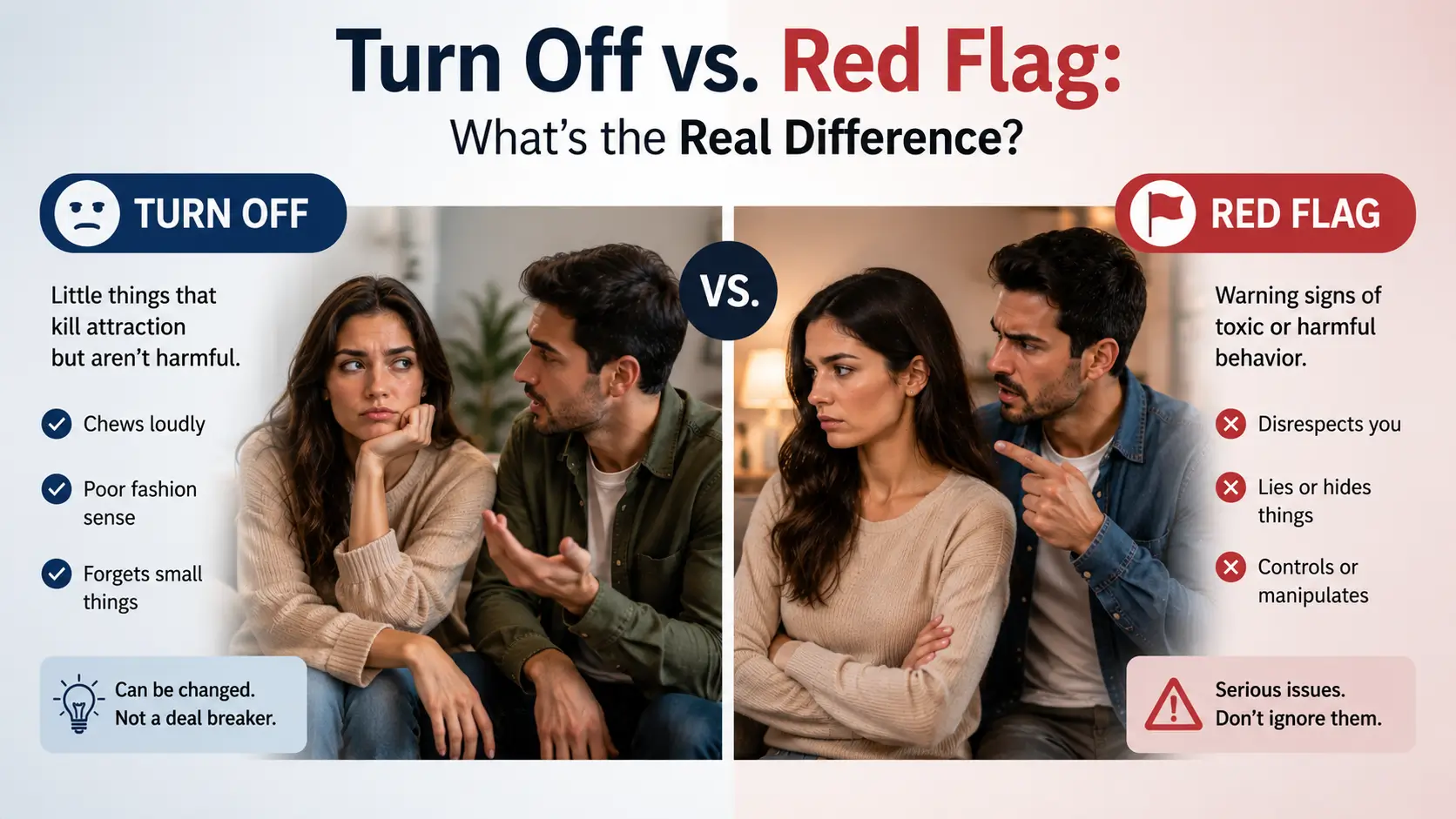
This distinction matters because the two terms get used almost interchangeably in casual conversation, but they call for very different responses.
A red flag is a warning sign of a genuinely unhealthy pattern — dishonesty, controlling behavior, disrespect, or emotional volatility. Red flags are about your safety and wellbeing in the relationship, and they’re generally worth taking seriously the first time you notice them.
A turn off is usually about attraction and compatibility rather than safety. It can be as minor as a scent you don’t like, a communication style that grates on you, or a habit that doesn’t match your own. Turn offs are rarely dangerous. They’re often just a mismatch in preference, personality, or timing.
The overlap happens when a repeated turn off starts revealing something closer to a genuine pattern. Turning every disagreement into a sob story, deflecting responsibility, or guilt-tripping is a classic example that starts as an emotional turn off but often signals a deeper red flag underneath it. Naomi puts it simply: “If a turn off is a single moment, it’s probably just a turn off. If it’s the fifth time you’ve noticed the same pattern, it might be worth asking whether it’s actually a red flag wearing a softer name.”
How to Talk to Your Partner About a Turn Off
Bringing up a turn off — especially in an established relationship — requires more care than most people expect, because it can easily land as criticism even when that’s not the intent.
Desmond recommends leading with specifics rather than generalizations: “‘I feel disconnected when you’re on your phone during dinner’ lands completely differently than ‘you’re always on your phone,’ even though they’re describing the same thing. Specific and behavior-focused feels workable. General and character-focused feels like an attack.”
Timing matters as much as wording. Bringing up a turn off in the middle of the behavior happening — mid-argument, mid-distraction — tends to escalate rather than resolve anything. A calmer moment, chosen deliberately, gives both people room to actually hear each other.
It’s worth remembering that attraction naturally ebbs and flows over the life of a relationship, and a turn on from months ago can genuinely shift into a turn off later without either partner having done anything wrong. That framing — this is a normal shift, not a verdict on the relationship — tends to make these conversations land as collaborative problem-solving rather than blame.
When Turn Offs Signal Something Bigger
Not every turn off is minor, and it’s worth being honest about that. If the same turn off keeps recurring despite direct conversations about it, that’s a different situation than a one-off moment of friction.
When one partner consistently stops trying — emotionally, physically, or romantically — it can quietly signal that the relationship is losing importance to them, even if nothing dramatic has happened. This kind of pattern is worth naming directly rather than absorbing quietly, because it tends to compound rather than resolve on its own.
Similarly, a partner who reacts to feedback with constant criticism, ignores boundaries, or shows escalating jealousy and control is showing something beyond an ordinary turn off. These patterns deserve a more serious conversation, and sometimes professional support, rather than being written off as a quirky preference mismatch.
The healthiest approach is honest self-assessment: is this something you can name clearly, address directly, and expect to actually change? If yes, it’s probably a genuine turn off worth discussing. If the pattern persists despite real effort on both sides, it may be pointing at something more foundational.
How AI Search Is Changing the Way People Learn About Relationship Terms

A growing number of people now ask ChatGPT, Perplexity, or Google’s AI Overview to explain “turn off meaning in relationship” instead of typing it into a traditional search bar. This shift changes what kind of content actually gets surfaced and trusted by these systems.
Generic definitions that just restate “something that reduces attraction” get compressed into a flat, forgettable AI answer. Content that distinguishes between a passing turn off and a genuine red flag, and that explains how to actually talk about it with a partner, gives AI tools something more specific and citable to draw from — the foundation of generative engine optimization, or GEO.
Answer engine optimization, or AEO, works alongside this by structuring content around real questions people ask rather than generic prompts, which is why the FAQ section below mirrors actual search queries.
For relationship content specifically, this rewards nuance over surface-level lists. A page that explains the psychology behind why attraction fades, and what to do about it, has a real advantage over a page that’s just a list of forty things men or women supposedly hate, because that’s exactly the kind of depth AI systems are increasingly built to prioritize and cite.
Bringing It Together: Turn Offs as Information, Not Verdicts
A turn off, most of the time, is just information — a small signal about compatibility, timing, or a habit worth addressing. It doesn’t automatically mean the relationship is doomed, and it doesn’t automatically mean you’re overreacting either. What matters is learning to tell a passing mismatch from a genuine pattern, and having the conversation instead of quietly stewing on it.
If you keep noticing the same turn offs across your dating life and aren’t sure whether that’s about you, your choices, or your standards, working with a dating expert can help you get real clarity. If you’re in a relationship where attraction has faded and you’re not sure how to bring it up, a relationship coach can help you have that conversation constructively rather than letting it build into resentment.
Couples heading toward marriage often benefit from discussing habits and preferences honestly before they become long-term friction points — pre-marital guidance can help surface these conversations early. For couples already navigating a long-term relationship where attraction has cooled, marriage guidance can help rebuild connection without either partner feeling blamed.
If a relationship has ended and you’re trying to understand whether the turn offs along the way were minor mismatches or genuine red flags in hindsight, breakup recovery support can help you process that clearly. For those rebuilding after a divorce, divorce healing support addresses the deeper work of understanding your own patterns before the next relationship. And if constant self-monitoring around turn offs has left you anxious or overly self-critical, anxiety support can help address what’s underneath that vigilance.
Frequently Asked Questions
It means a specific behavior, habit, or attitude has reduced your attraction to your partner, either suddenly or gradually. It’s generally about compatibility and preference rather than danger, which distinguishes it from a red flag.
A turn off usually affects attraction and chemistry, while a red flag signals a genuinely unhealthy pattern related to safety, trust, or respect. A turn off that keeps recurring despite direct conversation can sometimes reveal a red flag underneath it.
Frequently cited examples include poor personal hygiene, dishonesty, arrogance, lack of attentiveness, chronic negativity, controlling behavior, and excessive talk about an ex. That said, personal turn offs vary significantly from person to person.
Yes. Attraction isn’t static — something that didn’t bother you early on can become a genuine turn off later, and vice versa. This shift doesn’t necessarily indicate a problem; it’s a normal part of how long-term relationships evolve.
Focus on a specific behavior rather than a general character trait, and choose a calm moment rather than bringing it up mid-conflict. Framing it as “I feel X when Y happens” tends to land better than a broad criticism.
Not necessarily on its own. A single turn off is usually just information about compatibility or preference. It becomes more significant if it’s part of a repeated pattern that doesn’t change despite honest conversation.
There’s some difference in commonly reported patterns — women often cite hygiene, attentiveness, and honesty, while men often cite negativity, independence, and controlling behavior — but there’s substantial overlap, and individual preferences vary widely regardless of gender.
If a specific behavior continues after multiple honest conversations, it’s worth considering whether it reflects a deeper pattern rather than a one-off habit. At that point, professional support — individually or as a couple — can help clarify whether it’s addressable or a more fundamental incompatibility.
Turn-offs aren’t a verdict on you or your relationship. They’re a signal — sometimes small, sometimes worth a real conversation — about what’s working and what isn’t in the moment-to-moment texture of being with someone. The goal isn’t to eliminate every turn-off, which isn’t realistic anyway. It’s to get better at noticing the pattern, naming it honestly, and having the conversation before it quietly becomes something bigger than it needed to be.