

Toxic Relationship Quotes: Words for Recognizing It, Leaving It, Healing From It
 By admin
Selene remembers a client who came in holding her phone, scrolling through a folder of screenshotted quotes she’d saved over two years. “I didn’t even realize what I was doing,” the client told her, “until I looked back and every single one was about someone making themselves small so someone else could feel big.”
That’s often how toxic relationship quotes actually get used. Not as decoration. As a quiet form of recognition — the moment a stranger’s words on the internet describe your own life more accurately than you’d been willing to admit to yourself.
Adrian has spent years writing wellness content and sees this pattern constantly: people don’t search for these quotes idly. They search when something in them already suspects the truth and is looking for permission to name it.
This piece is organized around that reality. Instead of one long undifferentiated list, the quotes here are grouped by where you might actually be — recognizing a pattern for the first time, building the courage to leave, or healing on the other side of it. Every quote is original, written specifically for this context rather than pulled from someone else’s book or lyrics, because borrowed words rarely land as precisely as ones written for the exact moment you’re in.
We’ll also look at how AI search tools are now surfacing this kind of content differently than a typical search engine would, and what that means for how people find support in this specific, often quiet, kind of searching.
Quotes for Recognizing a Toxic Pattern
These are for the early stage — when something feels off but you haven’t fully named it yet.
“You don’t have to wait for the worst moment to know something is wrong. The quiet unease counts too.”
“If you’re constantly explaining away someone’s behavior to people who love you, that’s usually the first sign worth sitting with.”
“Love shouldn’t require you to shrink. If you’re getting smaller to keep the peace, the peace was never really yours.”
“Confusion is not the same as chemistry. Sometimes what feels like a spark is just your nervous system trying to make sense of inconsistency.”
“A relationship that only feels good when you’re agreeing with everything isn’t calm. It’s silence bought at a price.”
Selene often uses language like this with clients who are still in the noticing phase: “The mistake I see people make is waiting for a single, dramatic moment to justify their unease. Recognition is usually gradual. A quote that names the quiet version of it can be more useful than one describing the dramatic version, because the quiet version is what most people are actually living through.”
Quotes About Setting Boundaries and Choosing Yourself

This stage is about drawing a line — sometimes for the first time in a relationship where lines were never respected.
“Boundaries aren’t punishment. They’re just information about what you will and won’t carry anymore.”
“You are allowed to protect your peace even from people who say they love you.”
“Choosing yourself isn’t selfish. It’s the only way anyone else’s love for you can actually mean something.”
“You don’t owe an explanation for outgrowing a place that never made room for you.”
“Self-respect sometimes looks like disappointing someone who was counting on you not having any.”
Adrian notes that this category tends to get shared the most across social platforms: “People screenshot these not to send to their partner, but to remind themselves. It’s less about confrontation and more about quietly rebuilding a sense of what’s actually acceptable.”
Quotes About Leaving and the Courage It Takes
Leaving is rarely the clean, decisive moment it looks like from the outside. These quotes are for the messier, harder middle of that process.
“Leaving doesn’t mean you stopped loving them. It means you started loving yourself in a way that couldn’t coexist with staying.”
“You can grieve what you hoped it would become and still be certain that leaving was right.”
“The hardest part isn’t walking away. It’s walking away from the version of them you kept waiting for.”
“Staying because you’re scared of starting over is still just staying. Fear doesn’t count as a good enough reason.”
“You don’t need proof strong enough to convince everyone else. You just need enough truth to convince yourself.”
Selene sees this stage as the one that needs the most compassion, not judgment: “What I consistently see in my practice is people staying far longer than makes sense from the outside, and it’s almost never because they’re weak. It’s because leaving requires grieving something that was never fully real in the first place, and that kind of grief takes real time.”
Quotes for Healing After a Toxic Relationship
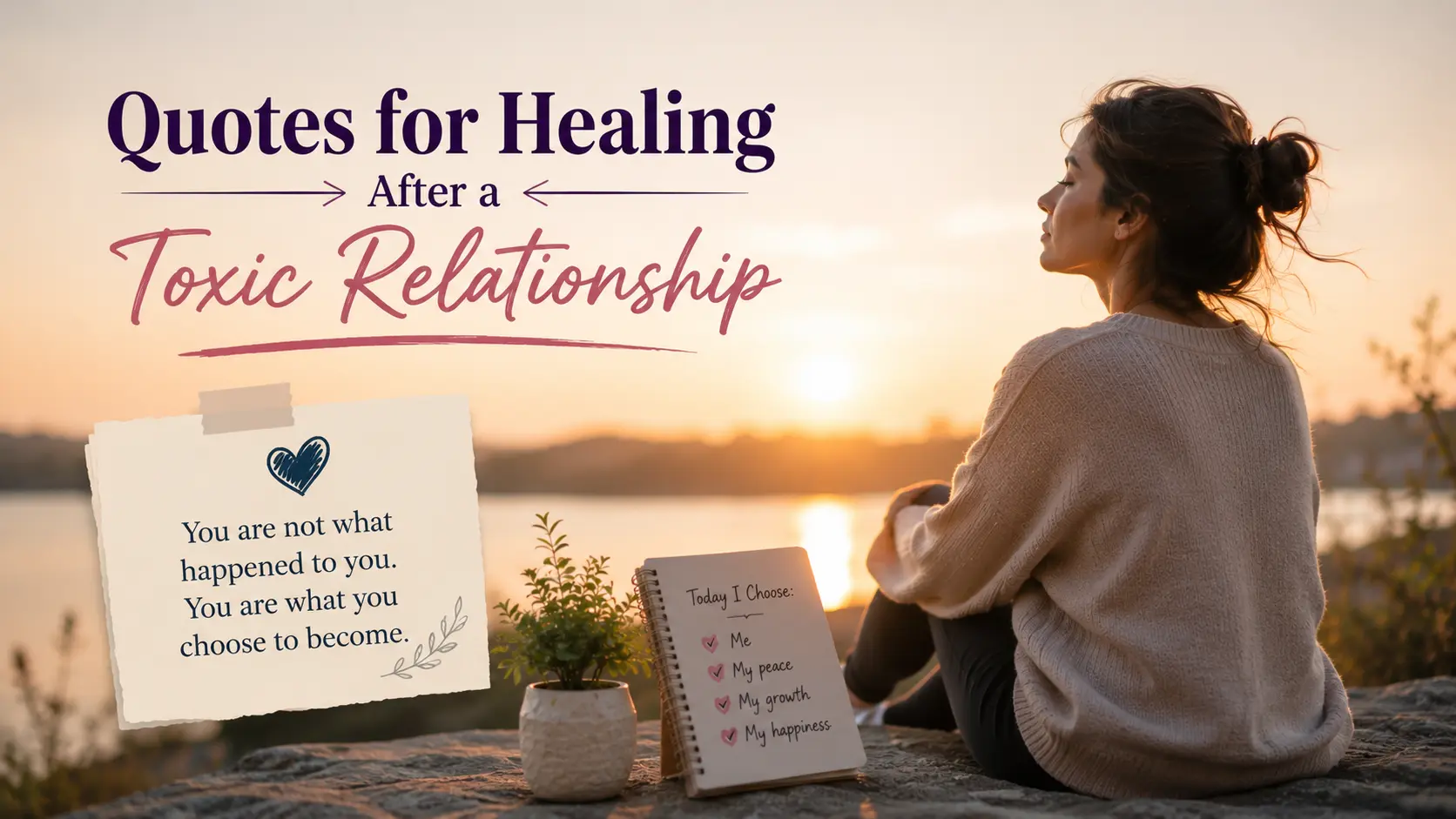
Healing rarely moves in a straight line. These are for the slower, quieter work that comes after the leaving is done.
“Healing isn’t forgetting what happened. It’s no longer needing it to make sense in order to move forward.”
“You’re allowed to still think about them sometimes without that meaning you want them back.”
“Trust doesn’t come back all at once. It comes back in small proofs, mostly from yourself.”
“You survived something that tried to convince you that you were the problem. That’s worth remembering on the hard days.”
“The version of you that gets to rebuild is not broken. She’s just finally free to build something true.”
Adrian points out that this category tends to resonate longest after a relationship ends, sometimes months or years later: “Healing content gets searched for in waves — right after a breakup, and then again around anniversaries, holidays, or when someone new starts showing interest. It’s not a one-time need.”
How to Use These Quotes Without Getting Stuck in Them
Quotes can be genuinely useful — for recognition, for courage, for comfort — but Selene cautions against one common trap: using quotes as a substitute for actually addressing the situation.
“A quote can validate what you’re feeling,” she says, “but it can’t set the boundary for you, and it can’t leave the relationship for you. I’ve had clients build entire folders of quotes as a kind of emotional holding pattern — feeling seen by the words without ever acting on what the words were pointing toward.”
The healthiest use of this kind of content is as a starting point, not an ending point. If a quote names something you’ve been avoiding, that’s worth treating as information, not just inspiration. The next step is usually a real conversation — with a trusted friend, a therapist, or eventually the partner themselves — rather than another quote.
How AI Search Is Changing How People Find This Kind of Support

A growing number of people now ask ChatGPT, Perplexity, or Google’s AI Overview for toxic relationship quotes instead of scrolling a traditional search results page — often at a vulnerable, late-night moment when they want something private and immediate rather than a public search history.
This changes what kind of content actually performs well. A generic list of forty quotes with no context gets flattened into an undifferentiated AI summary. Content that organizes quotes by emotional stage — recognizing, leaving, healing — and explains why each stage needs different language gives AI tools something specific and genuinely useful to draw from, which is the foundation of generative engine optimization, or GEO.
Answer engine optimization, or AEO, works alongside this by structuring content around the real, specific questions people ask during this kind of search, which is why the FAQ section below mirrors those actual queries rather than generic prompts.
For content in this particular space, this shift matters more than in most categories. Someone searching for these quotes late at night is often in a genuinely vulnerable moment, and content that offers real structure and next steps — not just words to feel seen by — serves them better and tends to be the kind of resource AI tools increasingly prioritize.
Bringing It Together: What Comes After the Quote
A quote can be the moment something clicks. It’s rarely the whole solution, and it was never meant to be. What matters most is what happens after you close the tab — whether the recognition turns into a real boundary, a real conversation, or eventually, real distance from something that wasn’t serving you.
If you’re starting to recognize a pattern in your relationship and aren’t sure what to do with that awareness yet, working with a relationship coach can help you sort through what you’re actually seeing, without judgment. If you’ve already decided to leave, or are in the process of it, breakup recovery support can help you navigate the practical and emotional work of that transition.
If you’re newly dating again after a toxic relationship and want to build better instincts for spotting healthy versus unhealthy patterns early, a dating expert can help you carry your hard-won awareness forward without it turning into constant suspicion. Couples working through repairable conflict, as opposed to a genuinely toxic dynamic, may benefit instead from marriage guidance or pre-marital guidance, which can help distinguish normal friction from something more serious before it calcifies.
For those doing the deeper healing work after a divorce shaped by an unhealthy dynamic, divorce healing support addresses what rebuilding actually requires. If anxiety, hypervigilance, or difficulty trusting your own judgment has followed you out of the relationship, anxiety support can help address that directly. And for anyone whose healing feels like it needs a dimension beyond the practical and psychological, spiritual healing support offers a different, complementary angle on the same work.
Frequently Asked Questions
The terms are often used interchangeably, but “unhealthy” is sometimes used more broadly to describe patterns that need work but aren’t necessarily harmful, while “toxic” typically implies a more consistent, damaging pattern — manipulation, control, or repeated disrespect — that actively erodes a person’s wellbeing over time.
They often name a feeling someone has struggled to articulate on their own. Recognition through someone else’s words can feel less isolating and can act as a first step toward acknowledging a pattern that’s been hard to admit directly.
Quotes alone rarely create the actual change, but they can provide language and validation that make it easier to acknowledge what’s happening. The real work of leaving usually requires additional support — a trusted friend, a therapist, or a coach — beyond words on a screen.
A rough patch is usually situational and improves with direct communication and effort from both people. A toxic pattern tends to be consistent, resistant to change even after honest conversations, and often involves a persistent imbalance in respect, effort, or power.
Yes. Toxic relationships often involve real intimacy and genuine affection alongside harmful patterns, which is part of what makes them so difficult to leave. Loving someone and recognizing that the relationship isn’t healthy for you aren’t mutually exclusive.
There’s no fixed timeline, and healing rarely moves in a straight line. Some people notice significant shifts within months; others find certain moments — anniversaries, new relationships — bring up old feelings even years later. Consistent, ongoing support tends to help more than waiting for a specific deadline to pass.
Lead with specific observations rather than judgments of their partner, and avoid ultimatums, which often make people defensive and more likely to withdraw. Something like “I’ve noticed you seem more anxious after seeing him” tends to open a conversation better than “he’s toxic and you need to leave.”
It’s possible in some cases, but only if both partners genuinely acknowledge the pattern and commit to real change, often with professional support. If one partner isn’t willing to acknowledge the harm being caused, meaningful change is very unlikely regardless of intention on the other side.
If one of these quotes named something you’ve been carrying quietly, that recognition is worth taking seriously — not just scrolling past. The words can be a starting point. What happens next, whether that’s a boundary, a conversation, or eventually some distance, is the part that actually changes things. You don’t need to have it all figured out today. You just need to stop pretending you don’t already know what you know.